

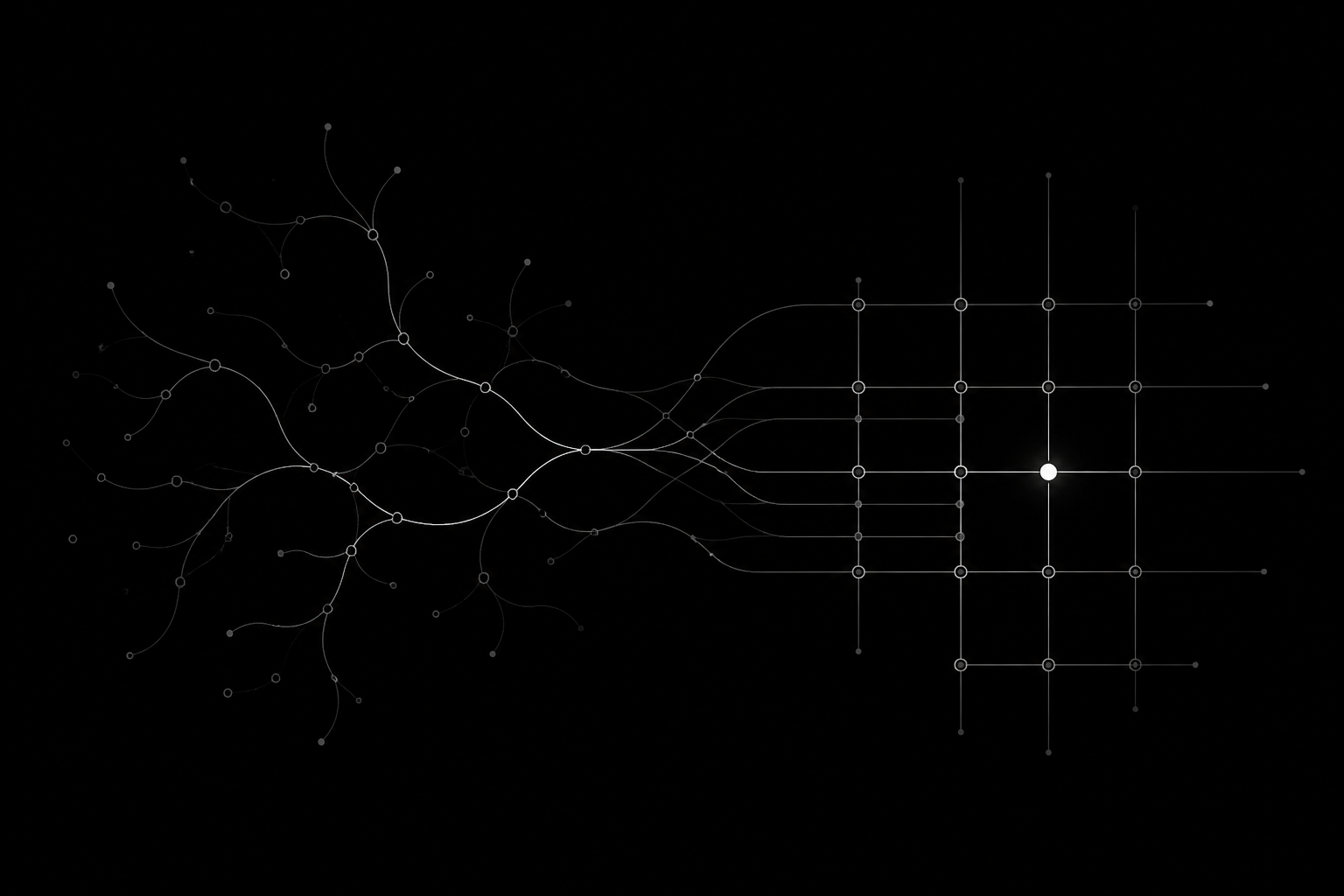
For decades, we adapted to software. We learned its interfaces, memorized its flows, accepted its rigidity. Every new tool promised to make work easier, but each one added another silo, another login, another session that starts from zero.
Even with AI, the pattern continued. Chat products gave us conversational interfaces, but no continuity. Copilots gave us suggestions, but no execution. Automation tools gave us scripts, but no context. Every interaction begins with the same question: What were we doing again?
That is not intelligence. That is a conversation that never ends and never compounds.
How we got here
The first generation of AI tools was built on a simple model: prompt in, response out. It was powerful enough to feel like magic, but fragile enough to forget everything the moment you closed the tab.
The second generation added agents. Agents can hold more context, use more tools, execute longer sequences of actions. But they still reset. They still operate in isolation. They still require you to re-explain your business, your preferences, your constraints — every single time.
The gap between what AI can do and what it actually does for you is not a model problem. It is an architecture problem.
The best models in the world are trapped inside a chat box, with no memory, no persistence, no operational context, and no ability to act on your behalf beyond generating text.
Organic Computing
Fractal is the first Organic Operating System. Not another chat product. Not another copilot. Not another wrapper around an API.
Organic computing is a fundamentally different model: the system accumulates context over time. It learns your patterns, remembers your decisions, understands your domain. The workspace adapts to what you are doing. Agents coordinate under your supervision. And everything persists — across sessions, across devices, across channels.
Four properties define it:
Persistent Intelligence. Intelligence does not reset every session. Memory, decisions, goals, and patterns survive across time. Instructions define what must always be followed and what must never happen. The system gets better the more you use it.

Adaptive Workspace. The interface is not fixed. Collections define your data. Views shape your interface. Need a CRM? The workspace becomes one. Need to manage an e-commerce catalog? It reshapes around that. Software that molds itself to your domain — not the other way around.

Agent Orchestration. Work is not limited to a single assistant. Fractal runs like a team: shared channels where multiple agents participate and interact, direct messages when you need one-on-one. Each agent can be assigned tasks, comment on work, and coordinate with other agents — autonomously, with human oversight.

Real Capabilities. Agents connect to the real world through toolsets — MCP servers, REST APIs, CLIs, custom integrations. They discover available tools automatically, call them with validated inputs, and receive structured results. And they can create new toolsets at runtime — expanding their own capabilities without human intervention.

Real Execution. Tasks can be scheduled to run at any point in time. Worktrees protect the main branch while agents work in isolation. Not trapped in a text box — performing actual work, with full auditability.

Why now
Three shifts make this possible today.
First, frontier models have become capable enough to handle multi-step, domain-specific work reliably. They can plan, reason, and execute — not just generate.
Second, the agent ecosystem has matured. Developers are already shipping agents that write code, manage infrastructure, and handle customer support. But each agent works in isolation. There is no shared context. No coordination layer. No system of record.
Third, the infrastructure for persistent, local-first computing has caught up. Local runtimes, cross-platform frameworks, and self-hosted intelligence make it possible to build a system that keeps your data on your machine while still connecting to cloud capabilities when you need them.
The pieces exist. What is missing is the operating system that connects them.
What this means
For a restaurant owner, Fractal becomes the team that knows the menu, tracks inventory, handles reservations, and coordinates suppliers — all through a conversation on WhatsApp. No app to learn. No interface to master. Just talk.
For a developer, Fractal becomes the orchestrator that assigns tasks to agents, creates isolated worktrees for each one, merges the results, and keeps the codebase clean — while the developer focuses on architecture and decisions, not mechanics.
For a founder, Fractal becomes the operating system that runs the company. Collections hold the data. Views render the dashboards. Agents execute the work. Instructions keep everything aligned. One system. No more stitching tools together.
The same platform. Different domain. The workspace adapts. The intelligence compounds.
What we are building
Fractal is in public alpha. We are building it with the people who will use it.
If you believe software should work the way you do — not the other way around — join the waitlist. Be part of shaping what comes next.
The moment software stops being rigid and starts becoming alive — that is the moment computing finally works for you.
Felipe Barcelos Founder, Nubler Digital